Rotation
15-Ball Rotation is a classic points-based pocket billiards game played with all fifteen object balls racked in numerical order. Players must always contact the lowest-numbered ball on the table first, but any ball pocketed on a legal shot counts for its numerical value. Because each ball carries increasing point value, the game blends precise cue ball control with long-term strategy — players aren’t just trying to run out, they’re managing scoring opportunities. The full rack contains 120 total points, and the goal is to reach a majority of them, making every shot — especially on higher-numbered balls — potentially match-defining.
The Rack
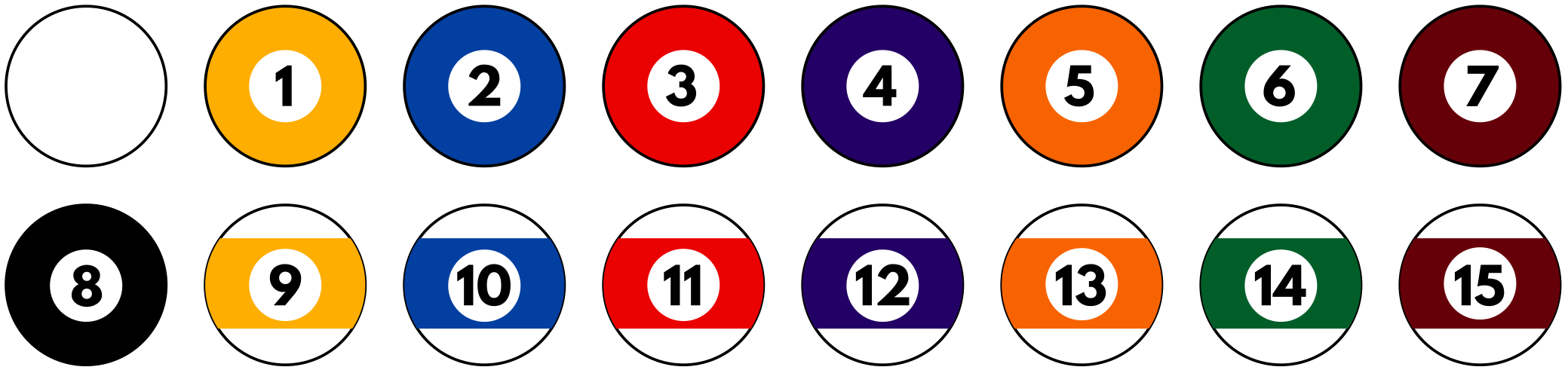
The cue ball and object balls 1 through 15 are used.
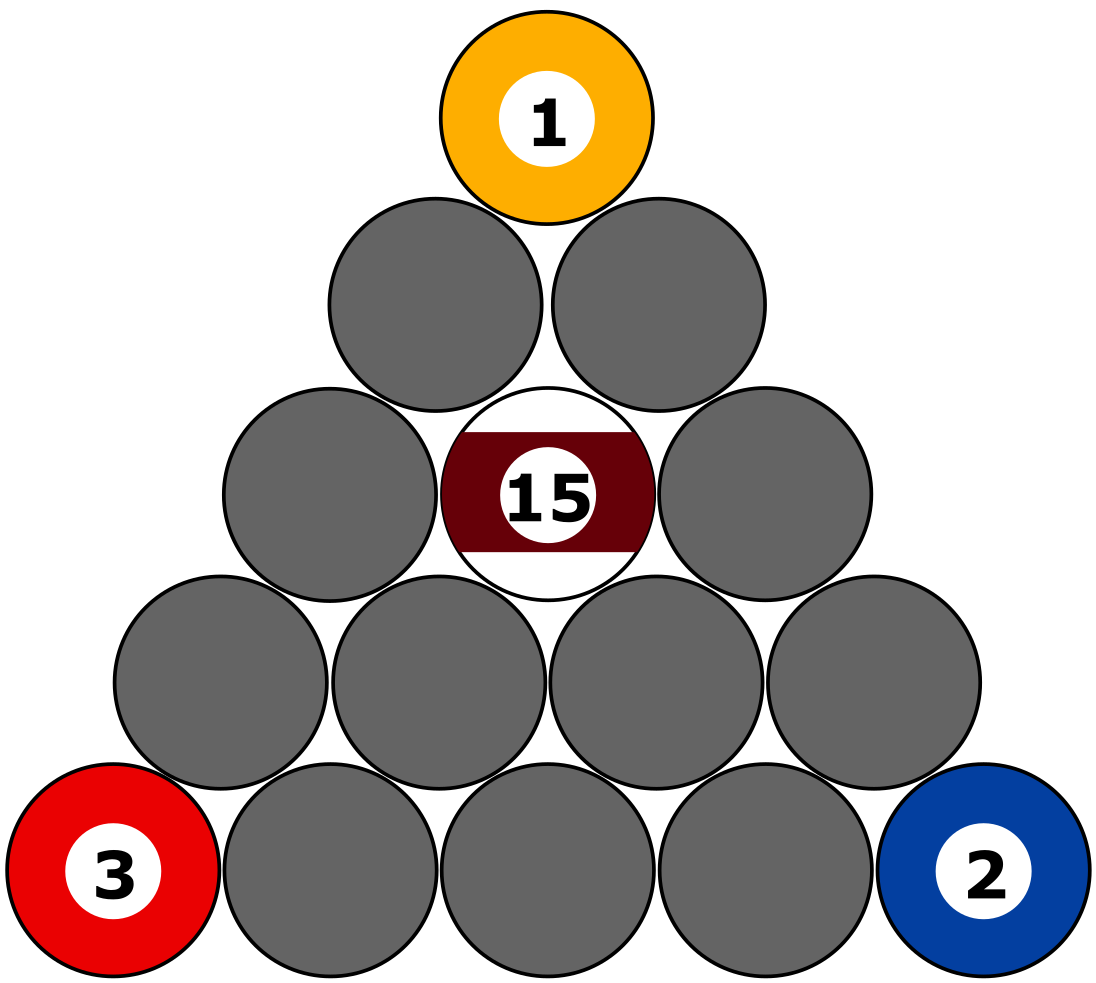
The fifteen object-balls are racked as tightly as possible in a triangle, with the 1-ball at the apex and on the foot spot, 2-ball on the rear right corner, 3-ball on the rear left corner, and 15-ball in the middle as the first ball that is directly below the apex. The other object-balls will be placed in the triangle without purposeful or intentional pattern.
Break Shot
Lag to determine first break.
The shooter begins with cue-ball in hand behind the Head String. On the break shot, the 1-ball must be struck first, or the shot is a foul.
To execute a legal break, the breaker must either pocket at least one ball, or drive at least four object balls to one or more rails.
Failure to meet these requirements is end of turn and the incoming player may choose to apply a foul penalty or have the balls re-racked and shoot the opening break shot.
Continuing Play
The first object-ball contacted by the cue-ball on each shot must be the lowest-numbered ball remaining on the table or else a Wrong Ball First foul is committed. If the shooter legally pockets any ball on a shot, he continues at the table for the next shot.
If the player has cue-ball in hand behind the head string and the legal object ball is also behind the head string, the object ball may be spotted.
In 15-Ball Rotation, a player may play only two safeties per rack that merely satisfy the minimum legal hit requirement (contacting the lowest-numbered ball and driving it to a cushion) without opening or advancing the rack. A third such safety is a foul.
Advancing or opening the rack means significantly changing the layout of the balls — such as driving multiple balls to cushions, breaking up clusters, or otherwise altering the table position beyond the minimum legal requirement.
Spotting Balls
All illegally pocketed balls or any ball driven off the table is spotted.
See Spotting Balls, Balls Settling, and Outside Interference for more information.
Scoring
Each legally pocketed object ball has a point value equal to its number. When a player's point total reaches or exceeds 61 points, the game is ended. If a tie occurs after all 15 balls have been pocketed, the player who pocketed the last ball wins the rack.
Standard Fouls
If the shooter commits a standard foul, play passes to his opponent. Incoming player has the option of accepting the balls in position or requiring offending player to shoot again with the table in position. If the cue-ball is in hand behind the headstring, it is so for either player.
- Bad Cue-Ball Placement
- Bad Play from Above the Head String
- The cue-ball is in hand above the Head String for the incoming player.
- Ball Driven Off the Table
- All object-balls driven off the table are spotted.
- Ball Rack Template Foul
- Balls Still Moving
- Cue-Ball Scratch or Off the Table
- The cue-ball is in hand above the Head String for the incoming player.
- Double Hit / Frozen Balls
- No Foot on Floor
- No Rail After Contact
- Playing Out of Turn
- Push Shot
- Three Consecutive Fouls
- Touched Ball
- Unsportsmanlike Conduct
- Wrong Ball First
For Three Consecutive Fouls, the penalty is loss of the current rack.
See Foul and Cue-Ball in Hand for additional information.