Aiming Line
The imaginary line through the cue-ball to the desired ghost-ball position to contact the object-ball for the shot.
Bad Cue-Ball Placement Foul
When the cue-ball is in hand and restricted to the area above the Head String, it is a foul to play the cue-ball from on or below the Head String.
Bad Play from Above the Head String Foul
When the cue-ball is in hand above the Head String, and the first ball the cue-ball contacts is also above the Head String, the shot is a foul unless the cue-ball crosses the Head String before that contact. If such a shot is intentional, it is unsportsmanlike conduct.
The cue-ball must either cross the Head String or contact a ball in front of or on the Head String or the shot is a foul, and the cue-ball is in hand for the following player according to the rules of the specific game. If such shot is intentional, it is also unsportsmanlike conduct.
Ball Driven Off the Table Foul
It is a foul to drive an object-ball off the table. Whether that ball is spotted depends on the rules of the game.
Ball Rack Template Foul
It is a foul when a Ball Rack Template, removed from the playing surface, interferes with the game, i.e., if the template is lying on the rail, and a ball (cue-ball or object-ball) touches the template that is lying on the rail.
Ball(s) Still Moving Foul
It is a foul to begin a shot while any ball in play is moving or spinning.
Ball Pocketed
A ball is pocketed if it comes to rest in a pocket below the playing surface or enters the ball return system. A ball near the brink of a pocket partly supported by another ball is considered pocketed if removal of the supporting ball would cause the ball to fall into the pocket. Possible situations include two balls jammed together in the jaws, or a full pocket with pocketed balls supporting a ball at the edge. Any such supported ball will be removed from the pocket and placed as if it had been pocketed according to the rules of the Discipline being played.
An object-ball that rebounds from a pocket back onto the playing surface is not a pocketed ball. If the cue-ball contacts an already pocketed ball, the cue-ball will be considered pocketed whether it rebounds from the pocket or not.
Ball(s) Settling
A ball may settle slightly after it appears to have stopped, possibly due to slight imperfections in the ball or the table. Unless this causes a ball to fall into a pocket, it is considered a normal hazard of play, and the ball will not be moved back. If a ball falls into a pocket as the result of such settling, it is restored as closely as possible to its original position. If a settling ball falls into a pocket during or just prior to a shot, and this has an effect on the shot, the ball will be restored to the position, and the shot will be replayed. The shooter is not penalized for shooting while a ball is settling.
Bank Shot
A shot in which the object ball is driven to one or more cushion before it is pocketed; incidental contact as a ball moves along and adjacent to a cushion does not count.
Break Shot
A break shot is the opening shot of a Match or Rack, depending on the Discipline. It happens when the object-balls have been racked, and the cue-ball is played from above the Head String usually with the intent of breaking the racked balls apart.
Chalk
A powdery block rubbed on the cue tip to increase friction. It helps prevent miscues by letting the tip grip the cue ball instead of slipping.
Concession
If a player concedes, he loses the match. For example, if a player unscrews his jointed playing cue-stick while the opponent is at the table and during the opponent’s decisive rack of a match, it will be considered a concession of the match.
Corner-Hooked
When the corner lip of a pocket blocks the path of the cue ball from contacting an intended object ball.
Corner Pocket
Any of the four pockets in each corner of a pool table. They have 90-degree apertures and as such are cut deeper than center pockets, which have 180-degree apertures.
Cue-Ball
The cue-ball is the ball that is struck by the shooter at the beginning of a shot. It is traditionally white but may be marked by a logo or spots. In pocket billiard Disciplines, a single cue-ball is used by both players.
Cue-Ball in Hand
When the cue-ball is in hand, the shooter may place the cue-ball anywhere on the playing surface and may continue to move the cue-ball until he executes a shot. Players may use any part of the cue-stick to move the cue-ball, including the tip, but not with a forward stroke motion. In some Disciplines and for most break shots, placement of the cue-ball may be restricted to the area above the Head String depending on the rules of the Discipline, and then Bad Cue-ball Placement and Bad Play from Above the Head String may apply.
When the shooter has the cue-ball in hand above the Head String and all the legal object- balls are above the Head String, he may request the legal object-ball nearest the Head String to be spotted. If two or more balls are equal distance from the Head String, the shooter may designate which of the equidistant balls is to be spotted. An object-ball that rests on the Head String is playable.
Cue-Ball Scratch or Off the Table Foul
If the cue-ball is pocketed or driven off the table, the shot is a foul.
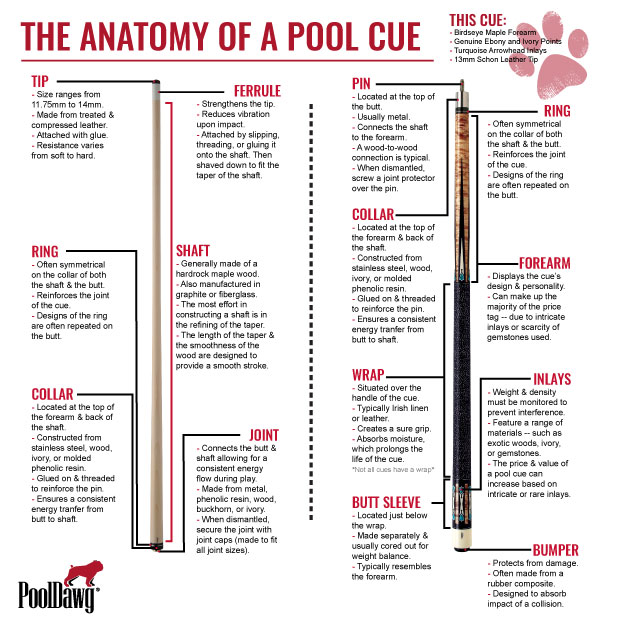
Cue-Stick
The main stick used to shoot the cue ball. It’s designed for control, accuracy, and consistent hits during normal play. Often just called a "cue".
Most cues come in two pieces: the butt (bottom) and the shaft (top).
The Butt:
- Bumper - A rubber piece at the base of the cue that protects it from impact and allows the cue to stand upright.
- Butt Cap - The rigid end piece of the butt that adds durability and often displays branding or weight access.
- Butt Sleeve - The decorative lower section of the cue butt, often featuring designs, rings, or inlays.
- Wrap - The grip area of the cue, made from linen, leather, rubber, or other materials to improve hold and control.
- Forearm - The section between the wrap and the joint, typically tapered and often the main design focus of the cue.
- Inlays - Decorative materials set into the cue’s surface for visual detail and craftsmanship.
- Collar - The reinforced ring at the joint end of the butt that helps align and protect the joint.
- Pin - The threaded metal rod that connects the butt to the shaft.
The Shaft:
- Joint - The connection point where the shaft attaches to the butt.
- Collar - The reinforced ring at the base of the shaft that mates with the butt collar for alignment and strength.
- Ring - Decorative bands near the joint or other sections of the cue, often matching butt designs.
- Shaft - The long, tapered playing portion of the cue that delivers the stroke to the cue ball.
- Ferrule - A short sleeve between the shaft and tip that absorbs impact and supports the tip.
- Tip - The leather striking surface that contacts the cue ball.
There are specialty cues designed for specific shots.
- A break cue is used to break the rack at the start of a game.
- A jump cue is used to pop the cue ball over another ball. They’re much shorter than a regular playing cue.
Typically a break cue and a jump cue are two separate cue-sticks, but sometimes you can find a single cue that performs both by having the butt break down into two pieces to shorten the overall length, these are called Jump/Break cues
Discipline
A generic term to describe a type of pool Discipline such as 8-ball or 9-ball.
Double Hit / Frozen Balls Foul
If the cue-stick contacts the cue-ball more than once on a shot, the shot is a foul. If the cue-ball is close to but not touching an object-ball and the cue tip is still on the cue-ball when the cue-ball contacts that object-ball, the shot is a foul. If the cue-ball is very close to an object-ball, and the shooter barely grazes that object-ball on the shot, the shot is assumed not to violate the first paragraph of this rule, even though the tip is arguably still on the cue-ball when ball-ball contact is made.
However, if the cue-ball is touching an object-ball at the start of the shot, it is legal to shoot towards or partly into that ball (provided it is a legal target within the rules of the game) and if the object-ball is moved by such a shot, it is considered to have been contacted by the cue-ball. (Even though it may be legal to shoot towards such a touching or “frozen” ball, care must be taken not to violate the rules in the first paragraph if there are additional balls close by.)
The cue-ball is assumed not to be touching any ball unless it is declared touching. It is the shooter's and opponent's responsibility to agree the declaration before the shot. Playing away from a frozen ball does not constitute having hit that ball unless specified in the rules of the discipline.
Driven Off the Table
A ball is considered driven off the table if it comes to rest other than on the playing surface but is not pocketed. A ball is also considered driven off the table if it would have been driven off the table except for striking an object such as a light fixture, piece of chalk or a player which causes it to return to the table.
A ball that contacts the top of the rail is not considered to have been driven off the table if it returns to the playing surface or enters a pocket
Driven to a Rail
A ball is said to be driven to a rail if it is not touching that rail and then touches that rail. A ball touching a rail at the start of a shot (said to be “frozen” to the rail) is not considered driven to that rail unless it leaves the rail and returns. A ball that is pocketed or driven off the table is also considered to have been driven to a rail. A ball is assumed not to be frozen to any rail unless it is declared frozen by the the shooter and/or the opponent.
Foul
A foul is an inappropriate or unfair act committed by a player which typically violates the rules of the organization or discipline being played. Most fouls result in a forfeit of turn, but more serious fouls, typically unsportsmanlike conduct fouls, could result in a forfeit of the rack or match. If several fouls occur on one shot, only the most serious one is enforced. If a foul is not called before the next shot begins, the foul is assumed not to have happen.
- Bad Cue-Ball Placement
- Bad Play from Above the Head String
- Ball Driven Off the Table
- Ball Rack Template Foul
- Balls Still Moving
- Cue-Ball Scratch or Off the Table
- Double Hit / Frozen Balls
- No Foot on Floor
- No Rail After Contact
- Playing Out of Turn
- Push Shot
- Three Consecutive Fouls
- Touched Ball
- Unsportsmanlike Conduct
- Wrong Ball First
Ghost-Ball
The imaginary aiming target where the cue-ball needs to impact the object-ball so the line through their centers (the impact line) is in the direction of the desired object-ball path.
Glove
Worn on the bridge hand to reduce friction between your hand and the cue. They help the cue slide smoothly, especially in humid conditions or for players with sweaty hands.
Inning
An inning is a player’s turn at the table. It begins when it is legal for him to take a shot and ends at the end of a shot when it is no longer legal for him to take a shot.
In some Disciplines a player may choose not to come to the table in certain situations when play would normally pass to him, and then the player remaining at the table continues the innings (e.g. a push-out at 9-Ball). The player whose turn it is to play is called the "shooter."
In some organizations, an inning is when both players/teams have completed their shot.
Jump Shot
A jump shot is one in which the cue-ball is made to go over an intervening obstacle such as an object-ball or part of the cushion. Whether such a shot is legal depends on how it is accomplished and the intention of the shooter. A legal jump shot is played by elevating the cue-stick and driving the cue-ball down into the playing surface from which it rebounds.
Kick Shot
A shot in which the cue ball banks off a cushion(s) prior to making contact with an object ball or scoring.
Kill Shot
A shot in which the cue ball is stroked in such a manner that virtually all of the speed and / or spin of the cue ball is transferred to the object ball, the cue ball retaining very little or none after contact.
Lag
The lag is the first shot of the Match and determines order of play. The player who wins the lag chooses who will shoot first.
A ball is placed on each side of the table above the Head String. The players will shoot at about the same time to make each ball contact the foot cushion with the goal of returning the ball closer to the head cushion than the opponent.
A lag shot is bad and cannot win if the shooter’s ball:
- crosses the Long String
- contacts the foot cushion other than once
- is pocketed or driven off the table
- touches the side cushion
- the ball rests within the corner pocket and past the nose of the head cushion
In addition, a lag will be bad if any non-object-ball foul occurs other than the Balls Still Moving foul.
The players will lag again if:
- a player’s ball is struck after the other ball has touched the foot cushion
- the referee cannot determine which ball has stopped closer to the head cushion
- both lags are bad
Match
A Match is a contest in a Discipline to the score required to win.
Mechanical Bridge
A stick with a shaped head that acts as a support for the cue when your hand can’t comfortably reach the shot. Often just called "the bridge" or "the rake."
Miscue
A miscue occurs when the cue tip slides off the cue-ball possibly due to a contact that is too eccentric or due to insufficient chalk on the tip. It is usually accompanied by a sharp sound and evidenced by a discoloration of the tip. Although some miscues involve contact of the side of the cue-stick with the cue-ball, unless such contact is clearly visible, it is assumed not to have occurred. A scoop shot, in which the cue tip contacts the playing surface and the cue-ball at the same time, and this causes the cue-ball to rise off the cloth, is treated like a miscue. If an unintentional miscue causes the cue-ball to leave the playing surface, including partially or fully jumping over a ball, it is treated like a legal jump shot. Intentional miscues may be considered unsportsmanlike conduct.
No Foot on Floor Foul
If the shooter does not have at least one foot touching the floor at the instant the tip contacts the cue-ball, the shot is a foul.
No Rail After Contact Foul
If no ball is pocketed on a shot, the cue-ball must contact an object-ball, and after that contact at least one ball (cue-ball or any object-ball) must be driven to a rail, or the shot is a foul.
If the cue-ball strikes a legal object-ball and a cushion at approximately the same instant, and it cannot be determined which was hit first, it will be assumed that the legal object-ball was struck first.
Object-Ball(s)
The object-balls are struck by the cue-ball with the usual intent of driving them into pockets. They are typically numbered from one to the number of balls used in the Discipline. Colors and markings of the object-balls are covered under the WPA Equipment Specifications.
Outside Interference
When outside interference occurs during a shot that has an effect on the outcome of that shot, the disturbed ball(s) will be restored to the position(s) before the shot, and the shot will be replayed. If the interference had no effect on the shot, the disturbed balls will be restored and play will continue. If the balls cannot be restored to their original positions, the situation is handled like a stalemate.
Playing Out of Turn Foul
It is a standard foul to unintentionally play out of turn. Normally, the balls will be played from the position left by the mistaken play. If a player intentionally plays out of turn, it is unsportsmanlike conduct.
Pool Table
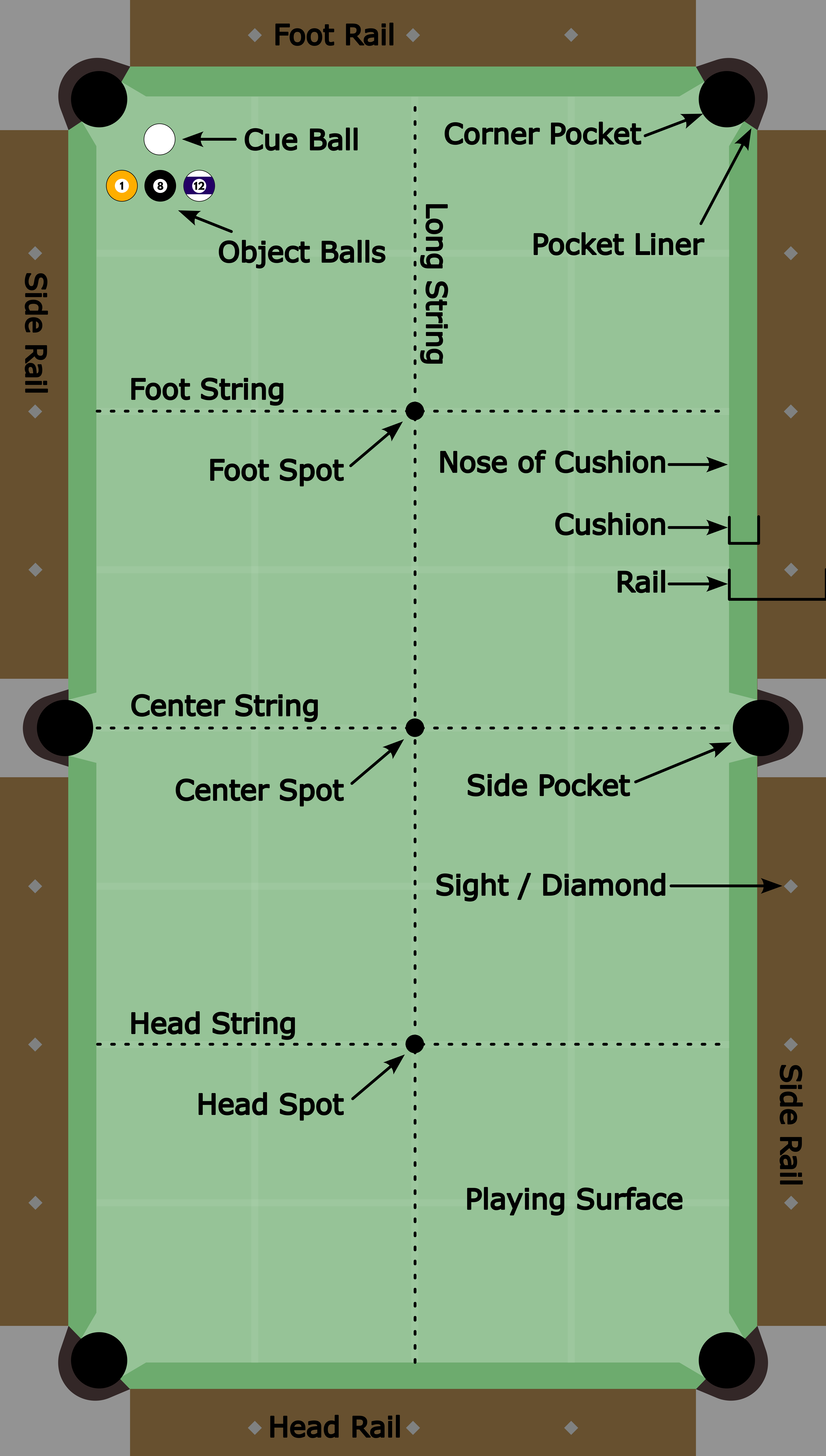
The table is comprised of rails cushions, a playing surface and pockets. The foot end of the table is where the object balls usually begin, while the head end is where the cue ball usually begins.
Behind the head string is the area between the head rail and the head string, not including the head string.
The cushions, tops of the rails, pockets and pocket liners are parts of the rails. There are four "strings" on the playing surface:
- the long string down the center of the table
- the head string bounding the quarter of the table closest to the head rail
- the foot string bounding the quarter of the table closest to the foot rail
- the center string between the two side pockets
The rails may have inlays referred to as diamonds or sights, which mark 1/4th of the width and 1/8th of the length of the table measured from nose to nose on the cushions.
On the playing surface, which is the flat, cloth-covered part of the table, the following will be marked if they are used in the game being played:
- the foot spot, where the foot string and the long string meet
- the head spot, where the head string and the long string meet
- the center spot, where the center string and the long string meet
- the head string
- the long string between the foot spot and the foot rail
- the triangle, either in outline or by alignment marks depending on the game
Position of Balls
The position of a ball is determined by the projection of its center vertically downward onto the playing surface. A ball is said to be placed on a line or spot when its center is placed directly over that line or spot.
Powder
A fine substance (like talc or hand powder) used to reduce friction on the bridge hand. It serves a similar purpose to gloves but is messier and less common in modern play.
Push-Out
In some disciplines, a push-out may be played immediately after the break. The player must make his intention known, and then rules Wrong Ball First and No Rail After Contact are suspended for the shot. If no foul is committed on a push out, the other player chooses who will shoot next.
Push Shot Foul
It is a foul to prolong tip-to-cue-ball contact beyond that seen in normal shots. Not to be confused with a Push Out shot.
Rack
A Rack in billiards can be used in multiple contexts as both a noun and a verb.
A Rack is a portion of a Match played with a single rack of object-balls.
A Rack is also considered the framing device, typically triangular, used to arrange the object-balls for the break shot. It also refers to the group of balls so arranged. To rack the object-balls is to group them with the rack.
Restoring a Position
When necessary for balls to be restored or cleaned, the disturbed ball(s) will be restored to their original position(s) as closely as possible.
Safety Shot
A safety shot occurs when a player makes a shot with the intention of not continuing their turn and leaving their opponent a tough shot.
If playing with the call-shot rule, the shooter may declare a "safety" before the shot. Play then passes to the other player at the end of the shot regardless if any balls were legally pocketed.
If not playing with the call-shot rule, delcaring a "safety" then legally pocketing a ball may require you to continue play.
Scratch
A shot on which the cue ball is pocketed is called a scratch.
Set
In some Matches, the Match is divided into parts called Sets, with a certain number of Sets won required to win the Match. In turn, a certain number of points or Racks won is required to win each Set
Side Pocket
One of the two pockets one either side of a pool table halfway up the long rails. They are cut shallower than corner pockets because they have a 180-degree aperture, instead of 90 degrees. In the UK the term centre pocket or middle pocket are preferred.
Shot
A shot begins when the tip contacts the cue-ball due to a forward stroke motion of the cue-stick. A shot ends when all balls in play have stopped moving and spinning. A shot is said to be legal if the shooter did not foul during the shot.
Spotting Balls
In some Disciplines, object-balls are required to be placed on the playing surface other than when forming a new rack. They are said to be spotted when they are so placed.
Balls are spotted (returned to play on the table) by placing them on the Long String (long axis of the table) as close as possible to the Foot Spot and between the Foot Spot and the Foot Rail, without moving any interfering ball. If the spotted ball cannot be placed on the Foot Spot, it should be placed in contact (if possible) with the corresponding interfering ball. However, when the cue-ball is next to the spotted ball, the spotted ball should not be placed in contact with the cue-ball; a small separation must be maintained. If all of the Long String below the Foot Spot is blocked by other balls, the ball is spotted above the Foot Spot, and as close as possible to the Foot Spot.
Stalemate
If no progress is being made towards a conclusion, the game is a stalemate. An example scenario would be a situation where both players are forfeiting their turns because any action taken may result in a win of the rack for the opposing player.
Standard Call Shot
In Disciplines in which the shooter is required to call shots, the intended ball and pocket must be indicated for each shot if they are not obvious. Details of the shot, such as cushions struck or other balls contacted or pocketed are irrelevant. Only one ball may be called on each shot.
For a called shot to count, the opponent must be satisfied that the intended shot was made, so if there is any chance of confusion, e.g. with bank, combination and similar shots, the shooter should indicate the ball and pocket. If the opponent is unsure of the shot to be played, he may ask for a call.
In call shot Disciplines, the shooter may choose to call "safety" instead of a ball and pocket and then play passes to the opponent at the end of the shot. Whether balls are being spotted after safeties depends on the rules of the particular Discipline.
Three-Ball Break Rule
On the break shot, a minimum of three object-balls must either be pocketed, or cross the Head String line, or a combination of both. For example, if one object- ball is pocketed, then at least two object-balls must cross the Head String line; or if two object-balls are pocketed, then at least one object-ball must cross the Head String line. To cross the Head String line means that the center (or resting point) of the object-ball must go beyond the line.
Three Consecutive Fouls
In some leagues and events, if a player fouls three times without making an intervening legal shot, it is a serious foul resulting a more severe penalty other than loss of turn (e.g. loss of rack or loss of points)
Touched Ball Foul
It is a foul to touch, move or change the path of any object-ball except by the normal ball-to-ball contacts during shots. It is a foul to touch, move or change the path of the cue-ball except when it is in hand or by the normal tip-to-ball forward stroke contact of a shot.
The shooter is responsible for the equipment he controls at the table, such as chalk, bridges, clothing, his hair, parts of his body, and the cue-ball when it is in hand, that may be involved in such fouls. If such a foul is accidental, it is a standard foul, but if it is intentional, it is unsportsmanlike conduct.
Unsportsmanlike Conduct Foul
Unsportsmanlike conduct is any intentional behavior that brings disrepute to the sport, or which disrupts or changes the game to the extent that it cannot be played fairly. It includes:
- distracting the opponent
- changing the position of the balls in play other than by a shot
- playing a shot by intentionally miscuing
- continuing to play after a foul has been called or play has been suspended practicing during a Match
- marking the table
- delaying the game
- using equipment inappropriately
Wrong Ball First Foul
In those games which require the first object-ball struck to be a particular ball or one of a group of balls, it is a foul for the cue-ball to first contact any other ball. If the cue-ball strikes a legal object-ball and a non-legal object-ball at approximately the same instant, and it cannot be determined which ball was hit first, it will be assumed that the legal object-ball was struck first.