One Pocket
One Pocket is a strategic discipline in which each player is assigned a single corner pocket and may only score balls in that pocket. Typically played to eight balls, players can pocket any object ball, but only balls made in their designated pocket count toward their total. With limited scoring opportunities and constant defensive exchanges, the game rewards patience, table knowledge, and creative shot selection. Rather than racing through open layouts, One Pocket is often described as chess on felt — a deliberate battle of control, traps, and long-term planning.
The Rack
The cue ball and object balls 1 through 15 are used.
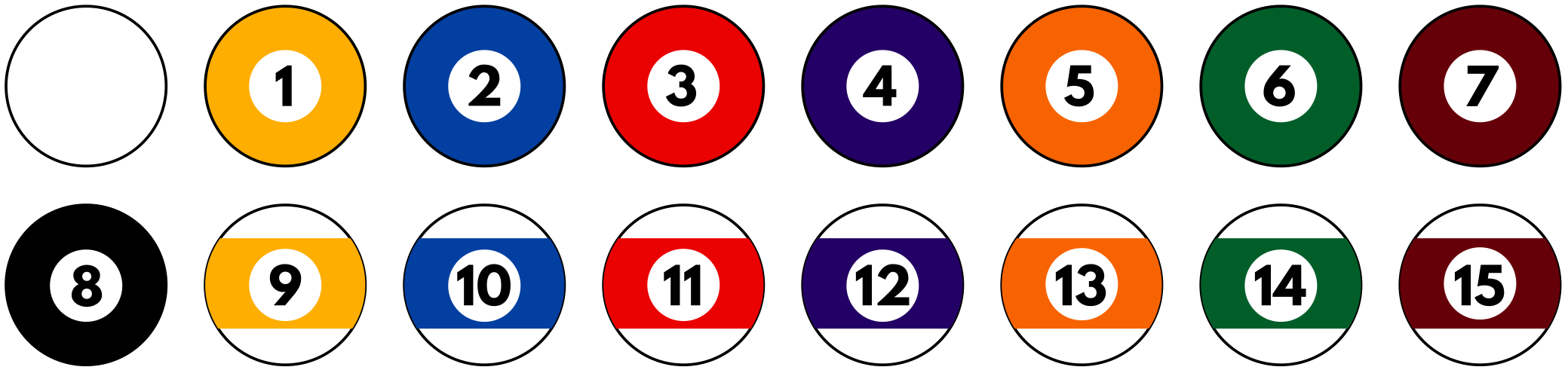
The fifteen object-balls are racked as tightly as possible in a triangle, with the apex ball on the Foot Spot. The balls are placed in the triangle without purposeful or intentional pattern. A Ball Rack Template will not be used for One-Pocket.
Break Shot
Lag to determine first break.
The breaker of each Rack will choose a pocket, and the opponent gets the other foot pocket. If the breaker does not explicitly indicate a pocket, they are assigned the foot pocket opposite to the side of the cue-ball placement for the break.
The cue-ball begins in hand above the Head String. There are no special requirements for the break shot.
Continuing Play
The shooter’s turn continues until they fail to pocket a ball in their pocket, foul, or the rack is won by a player reaching eight points. The incoming player shoots from the position left by the previous player except when they have ball in hand above the Head String.
Each ball legally pocketed in one of the foot pockets counts one point for the corresponding player. In addition, balls pocketed in the opponent's pocket on a foul shot count for the opponent and are not spotted below unless a cue-ball foul is also committed.
When a foul occurs, one of the fouler's scored balls is spotted as the one-point penalty in addition to any other balls that need to be spotted at that time. If a player has no ball to spot for a foul, a marker is placed to indicate a ball is owed. If the player later scores balls, they are spotted to cancel any owed balls.
Spotting Balls
Balls are spotted if they have been pocketed on a foul shot, pocketed in a side or head pocket, or driven off the table. Balls are also spotted as a penalty for a foul or to pay for previous fouls (owed balls).
Spotting is usually done at the end of the shooter’s turn, but if the shooter clears the table and has not reached eight points, perhaps due to balls having been pocketed in extraneous pockets, all balls to be spotted are spotted at that time and the shooter continues their turn.
If a ball is not spotted when it should be and is later noticed, it will normally be spotted when each player has had one full turn after the discovery. Alternatively, if both players agree, the ball will be spotted immediately.
See Spotting Balls, Balls Settling, and Outside Interference for more information.
Standard Fouls
If the shooter commits a standard foul they lose one point, balls are spotted as necessary, and play passes to the opponent. The cue-ball remains in position except as noted below. The following are standard fouls at One-Pocket:
- Bad Cue-Ball Placement
- Bad Play from Above the Head String
- For a foul under the second paragraph of this foul definition, the cue-ball is in hand above the Head String for the incoming player.
- Ball Driven Off the Table
- Balls Still Moving
- Cue-Ball Scratch or Off the Table
- The cue-ball is in hand above the Head String.
- Double Hit / Frozen Balls
- No Foot on Floor
- No Rail After Contact
- Playing Out of Turn
- Push Shot
- Three Consecutive Fouls
- Touched Ball
- Unsportsmanlike Conduct
For Three Consecutive Fouls, the penalty is loss of the current Rack.
See Foul and Cue-Ball in Hand for additional information.
Stalemate
If a stalemate occurs, all 15 balls will be re-racked, and the players will lag to see who has the next shot. Any markers for owed balls will be preserved and positive partial scores from the abandoned Rack will be carried over to the rerack.
See Stalemate for additional information.
Simultaneous Win
If a player scores both their winning ball and the opponent’s winning ball on the same shot the win is given to the shooter. (This can only happen with a score handicap or a stalemate rerack.)