Equipment
Pool Table
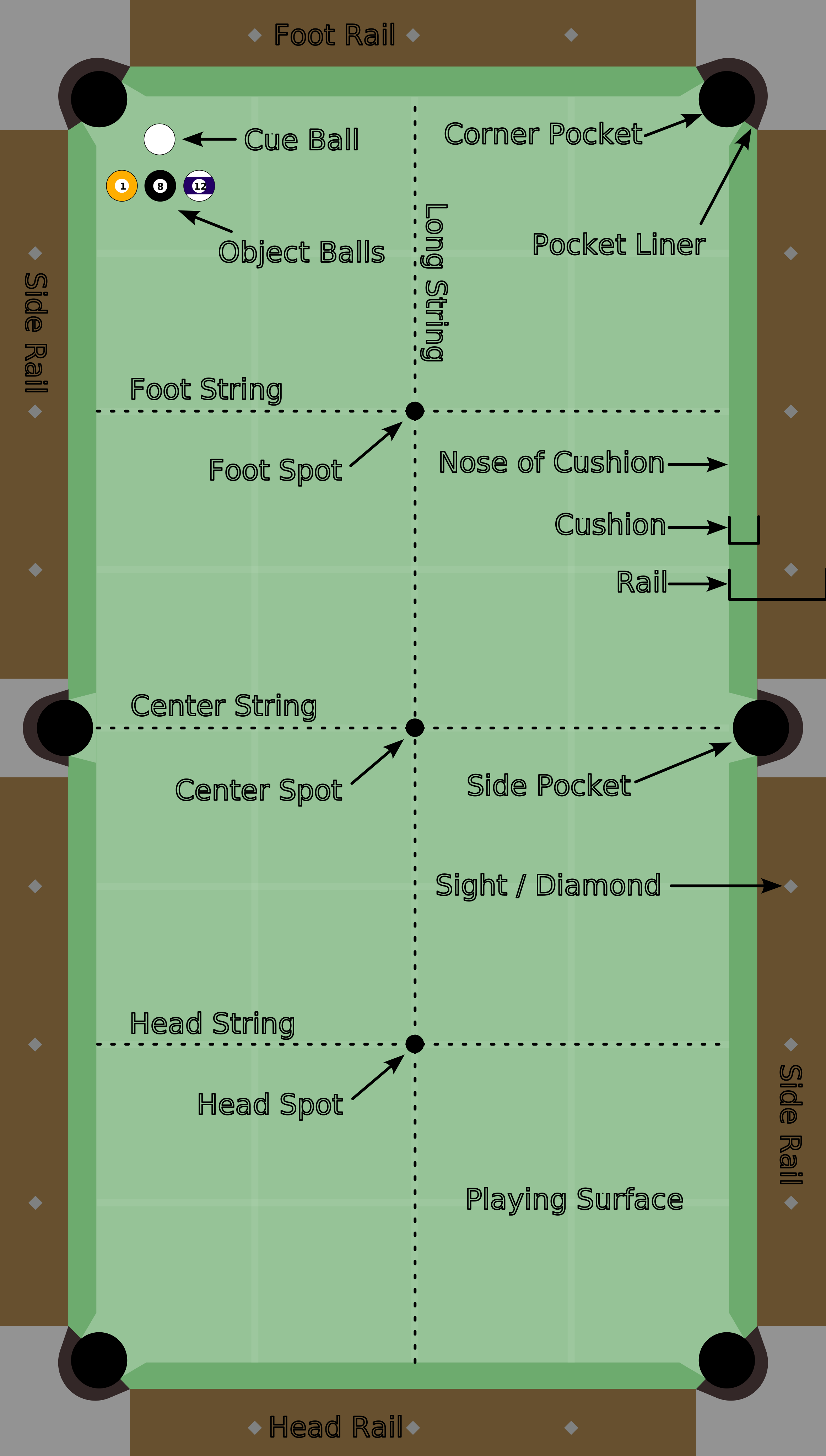
The table is comprised of rails cushions, a playing surface and pockets. The foot end of the table is where the object balls usually begin, while the head end is where the cue ball usually begins.
Behind the head string is the area between the head rail and the head string, not including the head string.
The cushions, tops of the rails, pockets and pocket liners are parts of the rails. There are four "strings" on the playing surface:
- the long string down the center of the table
- the head string bounding the quarter of the table closest to the head rail
- the foot string bounding the quarter of the table closest to the foot rail
- the center string between the two side pockets
The rails may have inlays referred to as diamonds or sights, which mark 1/4th of the width and 1/8th of the length of the table measured from nose to nose on the cushions.
On the playing surface, which is the flat, cloth-covered part of the table, the following will be marked if they are used in the game being played:
- the foot spot, where the foot string and the long string meet
- the head spot, where the head string and the long string meet
- the center spot, where the center string and the long string meet
- the head string
- the long string between the foot spot and the foot rail
- the triangle, either in outline or by alignment marks depending on the game
Cue-Ball
The cue-ball is the ball that is struck by the shooter at the beginning of a shot. It is traditionally white but may be marked by a logo or spots. In pocket billiard Disciplines, a single cue-ball is used by both players.
Object Balls
The object-balls are struck by the cue-ball with the usual intent of driving them into pockets. They are typically numbered from one to the number of balls used in the Discipline. Colors and markings of the object-balls are covered under the WPA Equipment Specifications.
Player Equipment
Cue-Stick
The main stick used to shoot the cue ball. It’s designed for control, accuracy, and consistent hits during normal play. Often just called a "cue".
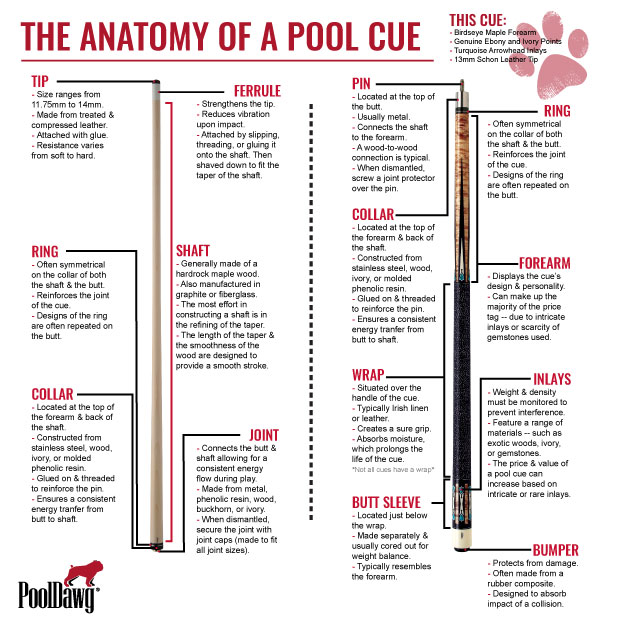
Most cues come in two pieces: the butt (bottom) and the shaft (top).
The Butt:
- Bumper - A rubber piece at the base of the cue that protects it from impact and allows the cue to stand upright.
- Butt Cap - The rigid end piece of the butt that adds durability and often displays branding or weight access.
- Butt Sleeve - The decorative lower section of the cue butt, often featuring designs, rings, or inlays.
- Wrap - The grip area of the cue, made from linen, leather, rubber, or other materials to improve hold and control.
- Forearm - The section between the wrap and the joint, typically tapered and often the main design focus of the cue.
- Inlays - Decorative materials set into the cue’s surface for visual detail and craftsmanship.
- Collar - The reinforced ring at the joint end of the butt that helps align and protect the joint.
- Pin - The threaded metal rod that connects the butt to the shaft.
The Shaft:
- Joint - The connection point where the shaft attaches to the butt.
- Collar - The reinforced ring at the base of the shaft that mates with the butt collar for alignment and strength.
- Ring - Decorative bands near the joint or other sections of the cue, often matching butt designs.
- Shaft - The long, tapered playing portion of the cue that delivers the stroke to the cue ball.
- Ferrule - A short sleeve between the shaft and tip that absorbs impact and supports the tip.
- Tip - The leather striking surface that contacts the cue ball.
Jump/Break Cue-Sticks
Specialty cues designed for specific shots.
- A break cue is used to break the rack at the start of a game.
- A jump cue is used to pop the cue ball over another ball. They’re much shorter than a regular playing cue.
Typically a break cue and a jump cue are two separate cue-sticks, but sometimes you can find a single cue that performs both by having the butt break down into two pieces to shorten the overall length.
Chalk
A powdery block rubbed on the cue tip to increase friction. It helps prevent miscues by letting the tip grip the cue ball instead of slipping.
Mechanical Bridges
A stick with a shaped head that acts as a support for the cue when your hand can’t comfortably reach the shot. Often just called “the bridge” or “the rake.”
Gloves
Worn on the bridge hand to reduce friction between your hand and the cue. They help the cue slide smoothly, especially in humid conditions or for players with sweaty hands.
Powder
A fine substance (like talc or hand powder) used to reduce friction on the bridge hand. It serves a similar purpose to gloves but is messier and less common in modern play.