9-Ball
9-Ball is a fast-paced rotation game played with balls numbered 1 through 9. Players must always contact the lowest-numbered ball first, but the rack can be won at any time by legally pocketing the 9-ball. Because of that rule, the game blends precision with controlled aggression — players may run patterns methodically or use combinations and caroms to finish early. With fewer balls on the table and constant offensive pressure, 9-Ball emphasizes cue ball control, shot-making confidence, and the ability to seize opportunities quickly.
The Rack
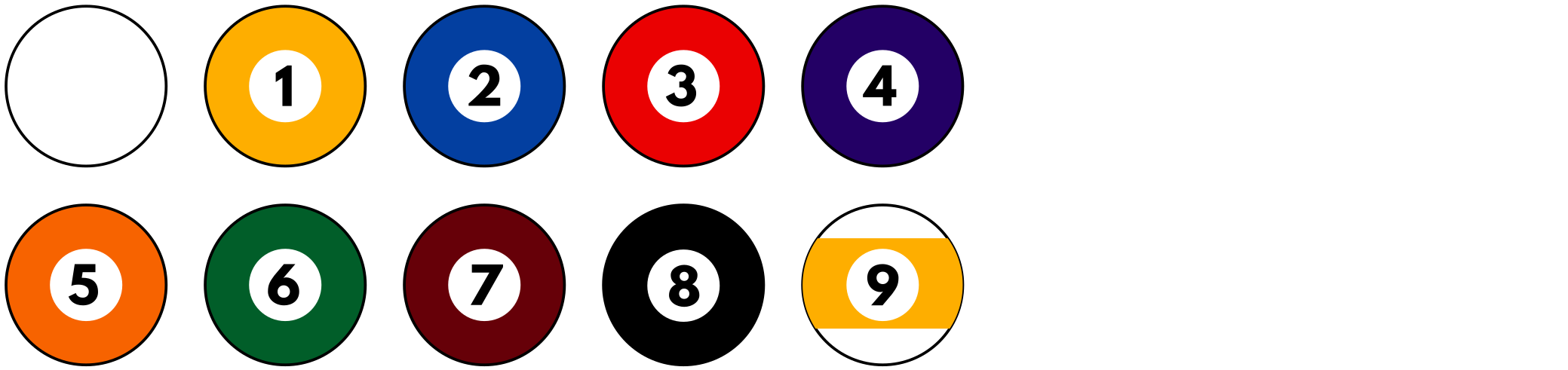
The cue ball and object balls 1 through 9 are used.
The object-balls are racked as tightly as possible in a diamond shape, with the 1-ball at the apex of the diamond towards the head of the table and the 9-ball in the middle of the diamond and on the Foot Spot. The other object-balls will be placed in the triangle without purposeful or intentional pattern.
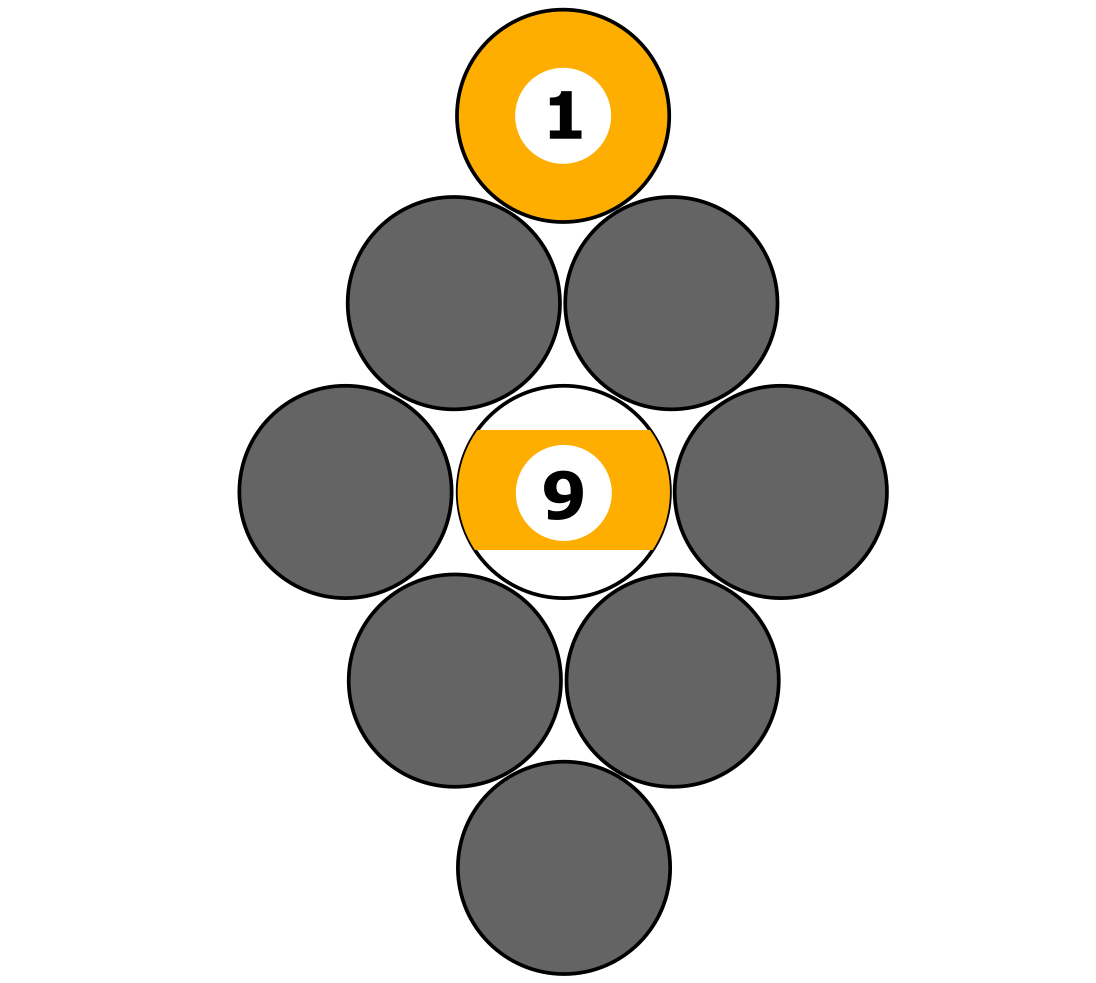
For most of the history of nine-ball, the 1-ball was placed on the foot spot and the 9-ball was placed in the center of the diamond rack.
In the 2000s, some events, especially in Europe — such as the Euro Tour and the Mosconi Cup — experimented with racking the 9-ball on the spot instead of the 1-ball as a way to limit easy break pocketing and make the break less automatic.
The World Pool-Billiard Association (WPA), which sets the official international rules, codified "9 on the spot" as the default racking method in their official rule set in 2025.
Break Shot
Lag to determine first break.
The shooter begins with cue-ball in hand behind the Head String. On the break shot, the 1-ball must be struck first, or the shot is a foul.
To execute a legal break, the breaker must either pocket at least one ball, or drive at least four object balls to one or more rails. Failure to meet these requirements is a foul. After a legal break, a push-out may be played as the next shot.
Three-Ball Break Rule
If the Three-Ball Break Rule is in effect, additional rules apply to the break shot:
If a player fails to meet the Three-Ball Break Rule, but otherwise makes a legal break, the incoming player has the choice to accept the table as is, or hand the shot back to his opponent.
- In accepting the table as is, the incoming player is not permitted to play a push-out.
- If the table is handed back to the breaker, the breaker is permitted to play a push-out. If so, the opponent will then have the choice to either play the shot, or hand it back.
If a player fails to meet the Three-Ball Break Rule but otherwise makes a legal break and pockets the 9-ball, the 9-ball is spotted before the next shot is played.
Continuing Play
The first object-ball contacted by the cue-ball on each shot must be the lowest-numbered ball remaining on the table or else a Wrong Ball First foul is committed.
If the shooter legally pockets any ball on a shot (except a push-out), he continues at the table for the next shot. If he legally pockets the 9-ball on any shot (except a push-out), he wins the Rack. If the shooter fails to pocket a ball or fouls, play passes to the other player, and if no foul was committed, the incoming player must play the cue-ball from the position left by the other player.
Spotting Balls
If the 9-ball is pocketed on a foul or push out, or driven off the table, it is spotted. No other object-ball is ever spotted. It is spotted prior to the next shot.
See Spotting Balls, Balls Settling, and Outside Interference for more information.
Standard Fouls
If the shooter commits a standard foul, play passes to his opponent. The cue-ball is in hand, and the incoming player may place it anywhere on the playing surface. The following are standard fouls at 9-Ball:
- Bad Cue-Ball Placement
- Ball Driven Off the Table
- Ball Rack Template Foul
- Balls Still Moving
- Cue-Ball Scratch or Off the Table
- Double Hit / Frozen Balls
- No Foot on Floor
- No Rail After Contact
- Playing Out of Turn
- Push Shot
- Three Consecutive Fouls
- Touched Ball
- Unsportsmanlike Conduct
- Wrong Ball First
For Three Consecutive Fouls, the penalty is loss of the current rack.
See Foul and Cue-Ball in Hand for additional information.
Stalemate
If a stalemate occurs the original breaker of the rack will break again.
See Stalemate for additional information.