The Pendulum Stroke
In this lesson, we are going to learn one of the most important aspects of developing a smooth, consistent, and mechanically sound stroke. In cue sports, consistency comes from repeatable motion, and repeatable motion comes from proper mechanics. To achieve this, we model the cue arm after a pendulum. When this motion is executed correctly, timing becomes more reliable and shot making becomes far more consistent.
Pendulum Mechanics
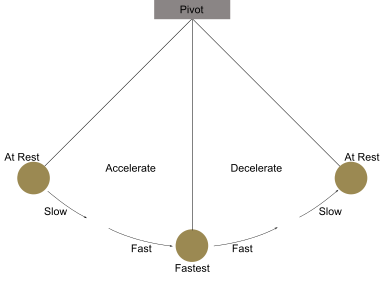
A pendulum moves in a predictable arc because gravity pulls it downward while it swings from a fixed pivot point. As it travels downward, it gradually increases in speed, reaching its maximum velocity at the very bottom of the arc. After passing that point, it begins to slow as it rises again. The key concept for our stroke is to time cue ball contact at the bottom of the swing, where maximum velocity occurs and the motion is at its most mechanically balanced and repeatable state.
Arm Mechanics
When we apply this model to the pool stroke, the elbow becomes the fixed pivot point, and the forearm and wrist function as the pendulum. The upper arm remains relatively stable while the forearm swings freely beneath the elbow, moving straight forward and back. As it moves forward, it naturally increases in speed just like the pendulum described earlier. At the lowest point, when the forearm is vertical, maximum velocity is reached, and cue ball contact should take place. In this position, the arm is most neutral and structurally aligned, making it the ideal moment for consistent contact.
Cue Grip
While the arm provides the pendulum motion, the cue must remain an extension of that movement. The grip should be relaxed and neutral, allowing the cue to move freely with the natural swing of the forearm. A tight or "death" grip introduces tension in the wrist and forearm, which can alter the stroke path and cause unintended steering. At cue ball contact, the forearm should be vertical and the wrist aligned naturally beneath the elbow, allowing the cue tip to travel straight through the shot line. When the arm swings freely and the grip remains relaxed, the cue stays straight and level through contact.
Body Alignment
For the pendulum model to function properly, the arm must be aligned with the intended line of aim from the start. The elbow, forearm, and wrist should be positioned directly on the shot line so the arm can swing straight forward and back without moving across the body. If the elbow is positioned inside or outside the aiming line, the forearm will naturally swing across the body rather than straight forward, forcing the player to steer the cue, adjust the wrist, or involve the shoulder to keep the shot on line. When alignment is correct, the motion stays true to the intended path and accuracy becomes far more reliable.
Conclusion
A smooth and consistent stroke is not built on force or effort, but on sound mechanics. By modeling the stroking arm after a pendulum, we simplify the motion into something predictable and repeatable. Mastering these fundamentals removes unnecessary variables and allows both accuracy and consistency to improve naturally.
Key Points
- The elbow acts as the fixed pivot point of the stroke.
- Only the forearm should move during the swing; the upper arm, shoulder, and body remain stable.
- The forearm and wrist function as the pendulum, swinging straight forward and back.
- Maximum velocity occurs at the bottom of the swing — this is where cue ball contact should take place.
- At contact, the forearm should be vertical and structurally aligned.
- The grip must remain relaxed to prevent steering or tension in the wrist.
- The stroking arm must be aligned with the shot line so it can swing straight through the ball.